Bus Delay
By Sam Banks. In Octabam Bus.
Chooser: FX2 (locked to its host track; the chooser cannot change it).
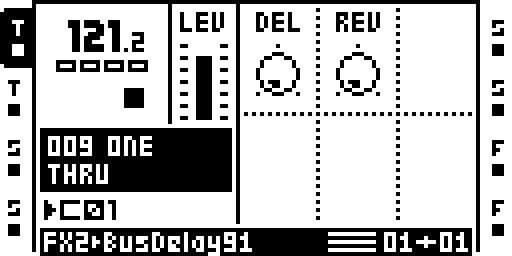
DELAY SERVER: the DELAY box in the TEMPO window, first rows.
The bus's delay engine, hosted on track 1's FX2 (locked; the FX2 chooser cannot change it). Three modes: CLEAN, GRAIN (a pitched granular cloud over the delay lines) and REVERSE, with a tape wow on the loop tap in every mode. The repeats come out on track 1; the reverb also hears them through its DLY knob. The delay follows the project tempo.
Access
Track 1's FX2 page draws only DEL and REV. Every other knob is in the TEMPO window: press [TEMPO], then LEFT / RIGHT to focus the DELAY box.
Adjust the sound
- DEL on track 1 sends track 1's own dry into the delay; REV sends it into the reverb.
- TIME is the delay time, a free dial that sticky-snaps to tempo divisions.
- FDBK is feedback, TONE the loop tone, PING the ping-pong bounce, WET the wet level.
- MODE: CLEAN, GRAIN or REVRS. GRAIN: SCTR is how far apart the grains read, DENS the density (level-flat), SIZE the grain length (GLEN 46 / 93 / 23 ms, XTRM 186 ms), PTCH the pitch ±2 octaves (64 = unison; a held MIDI note overrides it). REVERSE: SIZE is the segment length (SLEN, XTRM = 371 ms); the output is mono and PING is forced off.
Controls
Each effect has two pages of six knobs, A to F; the PAGE keys switch between them.
Page 1
| Knob | Name | Values | Default | What it does |
|---|---|---|---|---|
| A | DEL | 0 to 127 | 0 | this track's own send into the delay |
| B | REV | 0 to 127 | 0 | this track's own send into the reverb |
| C | FDBK | 0 to 127 | 60 | feedback: how much each repeat regenerates |
| D | TONE | 0 to 127 | 100 | tone of the repeats: lower is darker on every pass |
| E | PING | 0 to 127 | 0 | stereo ping-pong; 0 is centred, the alternation comes in over the top quarter |
| F | WET | 0 to 127 | 127 | level of the repeats on this track (the reverb's DLY sets what the reverb hears) |
Page 2
| Knob | Name | Values | Default | What it does |
|---|---|---|---|---|
| A | MODE | CLEAN / GRAIN / REVRS | CLEAN | engine: CLEAN, GRAIN (a pitched granular cloud) or REVRS (reverse) |
| B | SCTR | 0 to 127 | 40 | GRAIN: how far apart the grains are read; no effect in CLEAN or REVRS |
| C | DENS | 0 to 127 | 127 | GRAIN: grain density, level stays flat; no effect in CLEAN or REVRS |
| D | SIZE | 46MS / 93MS / 23MS / XTRM | 93MS | GRAIN: grain length 46, 93 or 23 ms, XTRM 186 ms. REVRS: segment length, XTRM 371 ms |
| E | PTCH | 0 to 127 | 64 | GRAIN: pitch +-2 octaves, 64 unison (a held MIDI note overrides); idle in other modes |
| F | TIME | 0 to 127 | 20 | delay time, 1.5 to 739 ms: a free dial that snaps to tempo divisions when close |
What MODE renames
| MODE | Knob | Reads as |
|---|---|---|
| CLEAN | B on page 2 (SCTR) | --- |
| CLEAN | C on page 2 (DENS) | --- |
| CLEAN | D on page 2 (SIZE) | --- |
| CLEAN | E on page 2 (PTCH) | --- |
| GRAIN | D on page 2 (SIZE) | GLEN |
| REVRS | E on page 1 (PING) | --- |
| REVRS | B on page 2 (SCTR) | --- |
| REVRS | C on page 2 (DENS) | --- |
| REVRS | D on page 2 (SIZE) | SLEN |
| REVRS | E on page 2 (PTCH) | --- |
Tempo Sync
By Sam Banks. In Octabam Bus.
Ties the bus delay to the project: the delay follows the project tempo
(the tempo itself is stock's), and its TIME knob reads as a tempo division
(1/8, say) while it sits on one, in milliseconds otherwise.
Operation
There is no menu: it works wherever the bus delay runs. A MIDI note held on the delay track's channel reaches the delay: in GRAIN mode it sets the grains' pitch in place of PTCH.
Screens
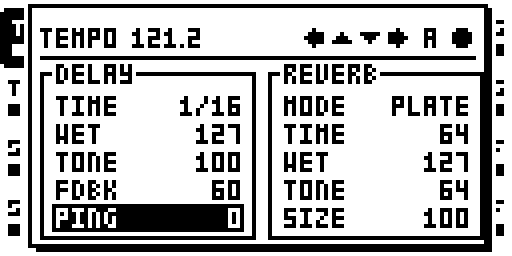
DELAY SERVER: the DELAY box in the TEMPO window, last rows.
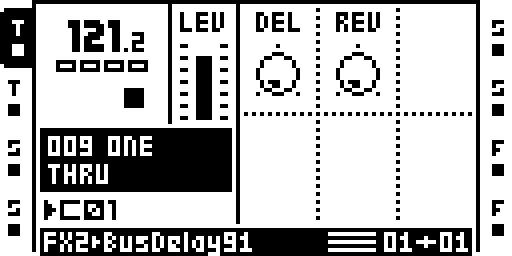
DELAY SERVER on track 1: the FX2 page (DEL and REV).