Behind the scenes
Services the features in this manual rely on. None of them has a menu or anything to set; they are listed here so that what you may notice has an explanation, and so that each is credited to its author.
- Effect Loader (Sender)
- Effect Loader (Copier)
- Load Meter
- Memory
- Store
- Pages
- Events
- Hooks
- Keybus
- Side-chain and Keybus Bridge
- Side-chain and Load Meter Bridge
- Remote
Effect Loader (Sender)
By Sam Banks. In Octabam and Octabam Verbs.
The effect loader, in two halves: this one and the copier. SPECTRUM, CHARACTER, MODULATION, SHATTER and COMPRESSOR's side-chain are not kept in the effects processor all the time: the loader brings one in while a track uses it and takes it out when none does. This half sends the code to the processor in small pieces.
What you will notice
- Until the code arrives, about 25 ms after you choose the effect, the effect passes the audio through.
- A pattern change that puts one of these effects on all eight tracks, or takes it off them, leaves about 0.34 s of silence at the switch.
- In Octabam, choosing a stock reverb (PLATE, SPRING or DARK) on the FX2 slot that shares its memory with a loaded effect is refused with a message, and so is the reverse. A song that sets both another way leaves the reverb or the effect dry, and says which at the next page key.
Effect Loader (Copier)
By Sam Banks. In Octabam and Octabam Verbs.
The other half of the effect loader (the sender). It copies the effect code the sender delivers into the effects processor's shared memory, where the effect runs. What you will notice is described under the sender.
Load Meter
By Sam Banks. In all three remixes.
Shows how busy the unit is: the share of the main processor taken by the audio frame interrupt, and how busy each DSP core is per frame. The bars are drawn on the LOAD tab of BRAIN's PERFORMANCE pane. Without this module the bars stay empty and the DSP tab says so.
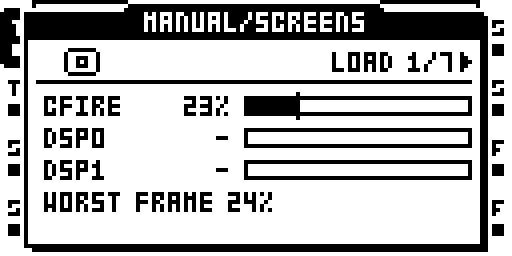
BRAIN performance: load display.
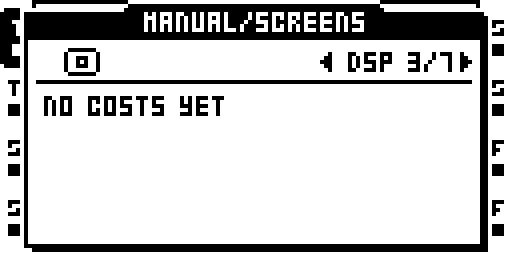
BRAIN performance: DSP display.
Memory
By Sam Banks. In all three remixes.
Sets aside the memory the added features need from the sample and recorder memory, sized for the modules in this image. BRAIN's PERFORMANCE pane, MEM tab, shows the split: DRAM RESERVE, RUNTIME, STAGE and REGIONS, then FLEX USED, FLEX FREE, RECORDERS, ARENA and IN USE.
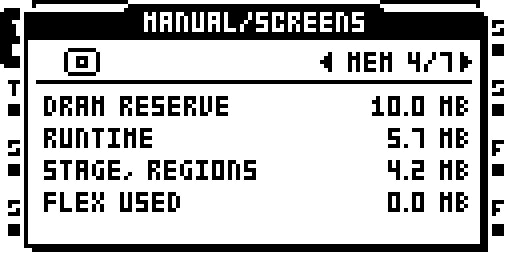
BRAIN performance: sample and recorder memory.
Store
By Sam Banks. In all three remixes.
Keeps each feature's extra files with the project: the Kits file, the page 2 lock files and the MIDI scenes file. They are written, copied and cleared at the right moments: every bank load, a new project, project save and reload.
In the Copy Project list, LEVEL scrolls only that list, as it does in the Kits lists.
Pages
By djib. In all three remixes.
PAGES lets several modules share a page key: pressing the key again on its own page steps through their pages, then back to the stock page. A double press still opens the stock setup.
Today it serves SRC on a MIDI track, for CHORDS FACTORY's page, and SRC on an audio track, for DRUMMER's KIT BALANCE page where an image has DRUMMER (the zones' mix, on a DRUMMER track only: on any other track the press does what stock does, nothing).
A page can also take parameter locks on steps and scenes, for the parameters its module declares lockable: hold a trig in GRID RECORDING (or a scene key) and turn a knob, as on a stock page. The locks play as stock's (from their step to the track's next trig; scenes on the crossfader), follow their trigs through copy, paste and clear, and are saved with the project. Today DRUMMER's KIT BALANCE takes them.
Events
By radiohagen. In all three remixes.
An internal service other features rely on. It tells them when the transport starts and stops, when MIDI arrives, which steps you are holding and when something is copied, so that PAGE 2 LOCKS and similar features can follow held-step edits and copy and undo.
Hooks
By Sam Banks. In all three remixes.
Lets two features share a part of the Octatrack's stock firmware that both of them want to change, so that both work together.
Keybus
By Sam Banks. In Octabam and Octabam Verbs.
Measures how loud each track is, every few milliseconds, and shares the levels with the effects that react to another track. It keeps two measures of each track: the peak, which CHARACTER's KEY and VOID read, and the average power, which VCA160's KEY reads.
Side-chain and Keybus Bridge
By Sam Banks. In Octabam and Octabam Verbs.
Lets the side-chain compressor and the track level measurement (Keybus) work in one image: both listen to every track at the same point, and this makes them share it.
Side-chain and Load Meter Bridge
By Sam Banks. In Octabam and Octabam Verbs.
Lets the side-chain compressor and the load meter work in one image. Both need to act when a track's FX2 is committed; this makes them take turns at that point instead of conflicting.
Remote
By Sam Banks. In all three remixes.
Lets a computer on the USB cable follow what the unit is doing: project loads and saves, start and stop, bank and pattern changes arrive as timestamped records, for hardware tests that wait for an event. The computer can also read memory, enter and leave USB DISK MODE, and start a remix from REMIX SWITCH's list.